
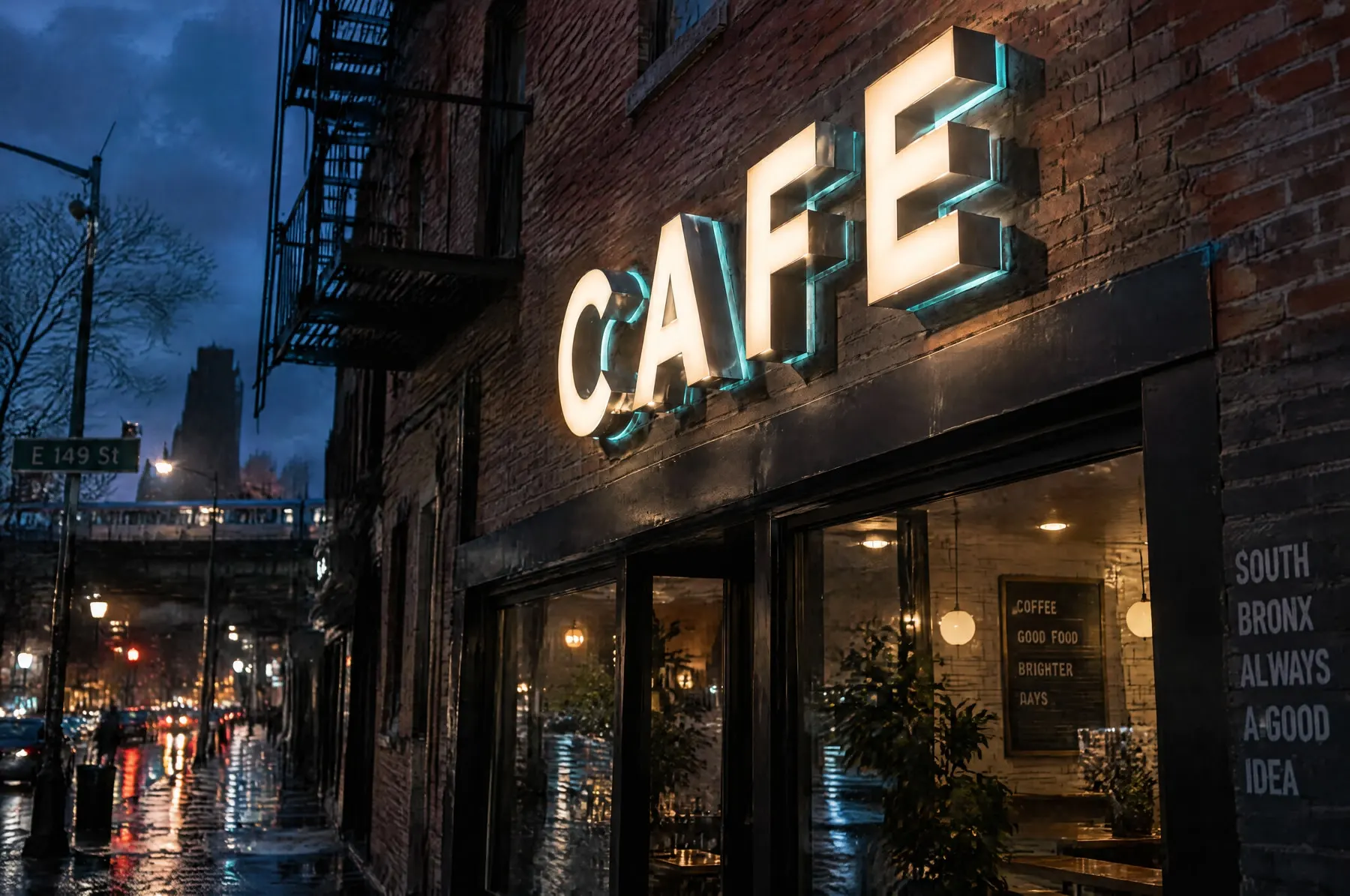
Channel letters and an illuminated cabinet solve the same problem from opposite ends. Channel letters are individual fabricated letters with the light source inside each letter. A cabinet sign — most people call it a light box — is a box with a printed or translucent face and lights behind it.
The two signs are different builds. A channel letter set is a dozen or more individual units, each with its own return, face and wiring; a cabinet is one frame, one face and one set of LEDs. That difference shows up in how they look at distance, how they are serviced, how long they take to build and how they are mounted. Those are the things that matter after the sign is on the wall.
What channel letters actually are
Each letter is its own fabricated unit: a 0.063-inch aluminum return, a 3/16-inch acrylic face, LED modules inside, and a low-voltage wire run back to a driver. We build them on 3rd Avenue, which means we control the return depth, the face color and the module spacing. That control is why a well-built set has no dark spots and no hot spots on the face.
Face-lit letters glow through the acrylic. Halo-lit letters have an opaque face and throw light backward onto the wall, which looks architectural at close range and fades at distance. Front-and-back does both and takes the most fabrication of the three.
What an illuminated cabinet actually is
A cabinet is an aluminum extrusion frame with a face on one or both sides and LED modules inside. The face is typically .040 to .125-inch acrylic or polycarbonate, printed or cut vinyl over a translucent substrate. A 12-foot cabinet is one continuous panel of graphics, which means a photo, a full logo lockup with a tagline, or a service list reproduces without being cut into letters.
Cabinets win on speed and on graphic complexity. Two to three weeks is a normal lead time because the frame is a standard extrusion and the face is printed, not fabricated letter by letter.
Side by side
| Channel letters | Illuminated cabinet | |
|---|---|---|
| Construction | 0.063″ aluminum returns, 3/16″ acrylic faces | Aluminum extrusion, .040 – .125″ faces |
| Lighting | UL-listed LED modules inside each letter | UL-listed LED modules inside the cabinet |
| Lead time | 3 – 5 weeks | 2 – 3 weeks |
| Best viewing distance | 80 – 300 ft, reads from a moving car | 40 – 200 ft, reads as one image |
| Graphic complexity | Limited to what a letter can carry | Full-color print, photos, service lists |
| Service access | Each letter opens on its own | The face comes off as one printed panel |
| Repair pattern | One letter or one driver at a time | One face or one driver |
| Warranty | 5 years on LED and drivers | 5 years on LED and drivers |
| Mounting | Raceway or direct mount, letter by letter | Mounts as one unit |
What drives the channel letter build
A set of 8 to 12 face-lit letters at 18 to 24 inches tall is the volume job. The adders are predictable, and each one is a fabrication decision.
- Halo lighting adds fabrication and install time over face-lit, because spacing and standoffs have to be precise for an even glow.
- A raceway, the aluminum channel that carries wiring across the wall, adds a fabricated part and a longer install.
- A new electrical circuit is electrician work, added when there is no junction box at the sign location.
- A curved, EIFS or uneven wall needs a backer or standoffs, quoted as separate structural work.
- Landmark review does not change the sign, but it changes the schedule by weeks.
What drives the cabinet build
Cabinets are specified by face area plus lighting and mounting. A 12-foot by 3-foot single-sided cabinet is 36 square feet. The simpler build is a flat printed face and a ladder install. The more involved build is a double-sided cabinet with a fabricated acrylic face and a lift.
A double-sided cabinet adds a second face and a second set of LEDs, so it is more work rather than twice the sign. Height matters more than size: a cabinet at 25 feet needs a lift and possibly a street closure, and that access work can take as long as the sign itself.
Letter height and reading distance
The old rule still works: one inch of letter height for every 10 feet of viewing distance. A 24-inch letter is readable at about 240 feet, which is most of a Bronx avenue. An 18-inch letter reads at about 180 feet. Below 12 inches, you have a pedestrian sign, which is right on a side street and wrong on a wide avenue.
A cabinet sidesteps the letter height question but introduces a worse one. If the face is a photo with a tagline set at 2 inches, the tagline is unreadable from 40 feet no matter how large the cabinet is. We set copy at reading size and keep the image simple, because a cabinet with too much information reads as a blur from the street.
Maintenance over ten years
Both types use UL-listed LED modules rated for 50,000 to 80,000 hours, and both carry a five-year warranty on LED and drivers when we build them. What differs is the failure pattern. A channel letter set fails one letter or one driver at a time, which looks like a missing letter at night. A cabinet fails one face section or one driver, which looks like a dark half.
A replacement channel letter face is a small fabricated part, matched to the letter it belongs to. A replacement cabinet face is a larger printed panel that covers a section of the sign. Both are service calls rather than a new sign, and both are the reason we keep face dimensions and paint codes on file for every job we install.
Which one to buy
- Choose channel letters on a prominent facade where the sign is the brand, the viewing distance is over 60 feet, and a custom look carries the rent.
- Choose a cabinet when the schedule is short, the site is simple, or the sign has to carry a photo, a service list or a multi-line message.
- Choose a cabinet for a pharmacy, deli, laundromat, clinic or auto shop where the sign repeats a category and a phone number.
- Choose channel letters for a restaurant, salon, hotel or professional office where the facade is part of what the customer is buying.
- On a long storefront with parking, use both: channel letters over the entrance and a cabinet or monument at the lot line.
Note from the shop: Both signs need a DOB sign permit in New York City when they are illuminated. The application needs dimensions before fabrication, so the choice between channel letters and a cabinet has to be made before the filing, not after.
If you are deciding between the two, send a photo of the facade and the width you have to work with. We will mock both at true scale on the building and quote them side by side, so you are comparing the actual signs on your actual wall. Call (718) 484-7372 or stop by 2450 3rd Ave in the Bronx. We serve all five boroughs, northern New Jersey and lower Fairfield County.