
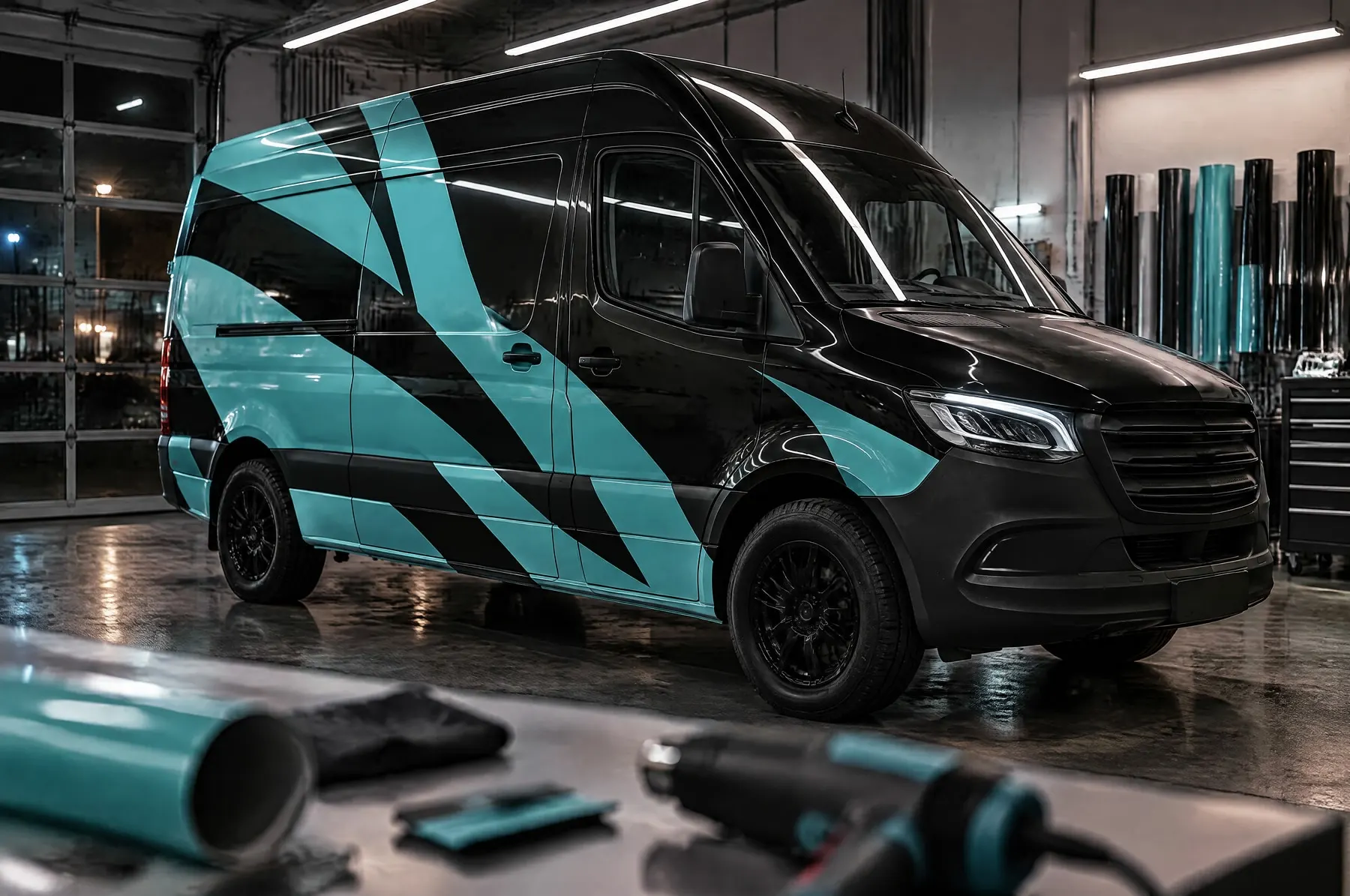
There is no flat rate for a vehicle wrap in New York City. A quote is built from film type, coverage, vehicle size, body complexity and install hours, and two vans of the same model can land in different places once the panels are inspected. Most of the vans we wrap at our shop on 3rd Avenue are mid-roof Transits and Sprinters with a standard cargo body and no ladder rack, and that clean body is the reason they are the simpler job.
The range is wide because a wrap is priced by film area and install hours, not by the badge on the grille. Two vans of the same model can differ by a full day of labor if one has rivets, a roof rack and rear-door hardware and the other has clean, flat panels.
The five things a quote is built from
When we price a van, we are answering five questions. What film are you buying? How much of the vehicle is covered? How large is the body? How complex are the panels? How many hours will the install take? Everything else is a detail inside one of those five answers.
Film type: cast versus calendered
3M IJ180 and Avery MPI 1105 are cast films, and cast film is what conforms to a wheel arch and a body crease without lifting two summers later. Calendered film is the lower-cost option, and it has memory — it wants to return to flat, which is why it fails at recesses first. We print on cast vinyl and laminate every panel with UV film. The laminate is not cosmetic: it carries the UV blockers, it protects the print from wash brushes and road salt, and it is the difference between a wrap that still reads at year five and one that looks chalky at year two. Gloss is standard, and matte and luster are specified the same way on most jobs.
Coverage: full, partial and what sits between
Coverage is the biggest lever on the job. Full means every painted panel except the roof on most vans. Partial means the front doors, one long side panel and a rear strip. Three-quarter coverage sits between the two and is usually drawn around the panels that get read in traffic.
| Coverage | What it covers | What it does to the quote |
|---|---|---|
| Full | Every painted panel except the roof on most vans | The most film and the most install hours; every panel is wrapped around its edges |
| Three-quarter | Sides, rear and part of the hood | Less film than a full wrap, but handles and trim still come off the wrapped panels |
| Partial | Front doors, one long side and a rear strip | Roughly half the film of a full wrap, on the panels people read first |
| Spot graphics | Logo and lettering on the doors and a rear panel | The least film; driven by setup and the number of pieces |
A partial wrap is the right call when the van is leased and you want a clean removal at turn-in, or when the vehicle also does deliveries and the rear panels take constant abuse. It is the wrong call on a dark van with a light brand color, because the unwrapped panels fight the design. It is also the wrong call if you plan to sell the vehicle with the graphics on it, because a full wrap photographs better.
Vehicle size and film area
A sedan takes 150 to 180 square feet of film and a cargo van takes 240 to 300, but the smaller vehicle does not shrink the job in proportion. Setup, design, bay time and travel are fixed costs, so the same setup is spread across less film. That is why a sedan carries the highest rate per square foot in the table and a box truck the lowest.
| Vehicle | Printed film, full wrap | What moves the quote |
|---|---|---|
| Sedan or small SUV | 150 – 180 sq ft | Small panels, tight recesses and glass; more trimming per square foot |
| Mid-size SUV or pickup | 200 – 240 sq ft | Larger flat panels, but a bed, a tailgate and a roof line add disassembly |
| Cargo van (Transit, Sprinter) | 240 – 300 sq ft | Long flat sides; rivets, racks and rear-door hardware add hours |
| Box truck, 16 – 20 ft body | 420 – 560 sq ft | The most film and the most print time; flat panels install quickly |
Body complexity: rivets, racks and recesses
This is where two identical vans stop being identical. We remove door handles, mirrors, badges and trim where the film needs to wrap around a panel instead of stopping at the edge. That disassembly is the part customers never see on a low quote, and it is the part that keeps the edges down. Rivets get a rivet cover or a relief cut. A ladder rack means the roof line is wrapped in pieces. Rear-door hardware means the film stops and restarts around hinges, latches and a backup camera. A box truck adds a cab, a body joint and often a riveted sidewall, and a 20-foot panel has nowhere to hide a bad seam.
Install labor and how long the shop needs the vehicle
Install runs 14 to 20 hours on a cargo van, spread over one or two days. The vehicle is usually back in service three to five business days after artwork approval, once the film is printed, laminated and trimmed. Fleet work is scheduled two to four vehicles per week so you are not missing the whole fleet at once. Bay time is a real input: a high-roof Sprinter needs a ladder or a lift for the upper panels, and that changes who does the install and how long the bay is tied up.
Design and artwork
Design is either included in the job or it is a separate line, and the difference is what you bring us. Print-ready artwork at final size with fonts outlined is a production job. A layout built for the vehicle — panel breaks, door cutouts, sightlines at the wheel arch — is a design job, and it is usually the difference between a wrap that reads in traffic and a logo floating in empty space. A layout drawn for a flat page does not survive a wheel arch.
Box trucks, Sprinters and high-roof vans
Box trucks carry the largest film area because the body is a long flat panel plus a cab, and flat panel is fast to install but slow to print. High-roof Sprinters add height, which means a ladder or a lift for the upper panels and more film waste at the roof curve. A wrapped box truck is the most visible asset most contractors own, and it is also the vehicle where a cheap install shows first.
Maintenance and how long the wrap lasts
Five to seven years on vertical panels in New York, three to four on hoods and roofs that take sun and salt. Hand wash with mild soap or use a touchless wash. Skip the brush tunnels, and keep a pressure washer 18 inches off any edge. A monthly hand wash will outlast any warranty claim.
What we will not do to win a job
We will not wrap over peeling clear coat, rust or paint that has not cured. The film will hold for a year and then take the paint with it on removal, and that repair is a bigger problem than the wrap. If your paint fails inspection, we tell you before you pay a deposit and we tell you what the body shop needs to correct.
Note from the shop: A wrap on a leased vehicle is generally fine, but read the lease. Some lessors require removal before turn-in, and some require written approval for graphics. We can install with removable adhesive and document the removal for you.
How to get an accurate quote
- Send daylight photos of all four sides, the roof line and any body damage.
- Tell us the year, make and model, and whether the roof is standard or high.
- Tell us whether you have print-ready art or need a layout designed.
- Tell us whether there is old vinyl or decals on the vehicle.
With those four things we quote a firm number instead of a range, usually within one business day, and the quote is free. Call (718) 484-7372 or bring the van to 2450 3rd Ave in the Bronx. We wrap vehicles for businesses across all five boroughs, northern New Jersey and lower Fairfield County.