
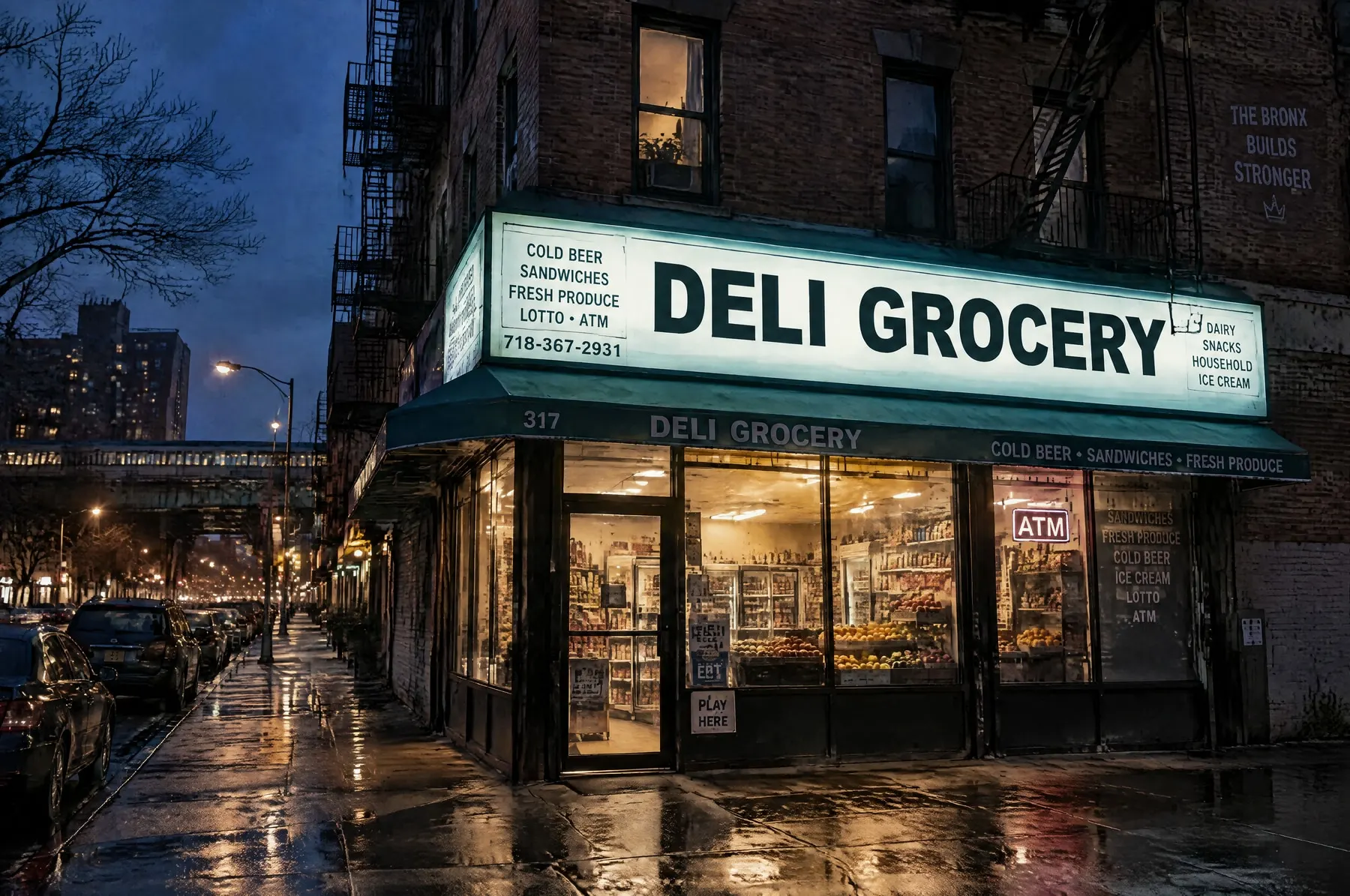
Most exterior signs on a commercial building in New York City need a Department of Buildings sign permit before anything is fabricated. Illuminated signs almost always need one. Projecting signs almost always need one. A building inside a designated historic district needs Landmarks Preservation Commission approval on top of the DOB filing.
We file sign permits for clients every week, and the same three questions come up on every job: does this sign need a permit, who has to approve it, and how long does it take. Here is the plain version, without the code citations.
When a sign permit is required
If the sign sits outside the building envelope — on the facade, above the storefront, projecting over the sidewalk, on the roof, or on a freestanding monument at the property line — assume it needs a DOB sign permit. Illuminated signs are the clearest case. The sign has an electrical connection and a structural attachment, and the filing covers both.
Signs that usually do not need a DOB sign permit: interior signs and banners, graphics applied to the glass, paper promotions, and menu boards inside the window. Those can still be restricted by your lease and by the landlord’s sign criteria, and a co-op or condo board can be stricter than the city is.
Signs that almost always need a permit before fabrication:
- Illuminated channel letters, cabinet signs and LED panels
- Projecting blade signs that hang over a sidewalk
- Awnings and canopies that project over the public right of way
- Monument and pylon signs at the property line
- Any change to the dimensions, height or location of an already permitted sign
Four approvals that are not the same thing
DOB sign permit
The Department of Buildings reviews the sign against the zoning district, the permitted sign area, the height and the mounting. The permit is issued for a specific sign at a specific address with specific dimensions. If the sign grows by six inches after approval, the filing has to be amended.
Landmarks Preservation Commission approval
If your building is in a designated historic district or is an individually designated landmark, the commission reviews the design before the DOB permit is complete. That review covers size, letter style, illumination and how the sign attaches to the historic facade. Districts in the Bronx include parts of Mott Haven and Longwood. We check the address before we quote a schedule, not after.
Sidewalk and right-of-way approval
A projecting sign, an awning or a canopy that hangs over the public sidewalk needs the city’s permission to occupy that space, separate from the sign permit. New York City also licenses the sign hangers who install hung and projecting signs, which is one reason the low bid on a blade sign is often not a legal install.
Landlord approval
Not a city approval, but it stops more signs than the DOB does. Most commercial leases require written consent, and many include a sign criteria package with approved colors, letter heights and illumination levels. We assemble a drawing set that answers those questions in one pass so the property manager is not asking for a third revision.
What the filing package includes
- A site plan showing the property line, the building and the sign location
- An elevation drawing with sign dimensions, letter height and mounting height
- The sign area calculation for the zoning district
- Attachment details, including blocking, fasteners and the substrate behind them
- Electrical information: LED load, driver location and the point of connection
- Photos of the existing condition plus the neighboring signs for context
- Owner or managing agent consent when the tenant is not the property owner
We measure the storefront ourselves. A filing built on a tenant’s guess about fascia height is a filing that gets returned, and a returned filing takes longer than the measurement would have.
How long the permit process takes
The permit is rarely the slow part. Landlord approval and landmark review are. Here is how the schedule runs on a typical Bronx storefront.
| Step | Who handles it | Typical time |
|---|---|---|
| Site survey and measurements | Our shop | 1 – 2 business days |
| Drawings and zoning check | Our shop | 3 – 5 business days |
| Landlord approval | You and our shop | 3 – 10 business days |
| DOB sign permit filing and review | Our shop | 2 – 4 weeks |
| Landmarks review, if applicable | Our shop with LPC | 4 – 10 weeks |
| Fabrication | Our shop | 3 – 5 weeks for channel letters |
| Install and inspection | Our shop | 1 day install, inspection within 2 weeks |
Six to ten weeks from signed quote to installed sign is realistic when the landlord is responsive and the building is not in a historic district. Add one to four months for landmark review. If someone promises a fully permitted illuminated sign in three weeks in a landmark district, they are either not filing or not telling you about the review.
Why filings get returned
- Sign area over the limit allowed in the zoning district
- Letter height or sign height above what the district permits
- A drawing that does not match the measured facade
- Missing electrical information or an electrician who is not licensed for the work
- A landmark building filed without the commission approval in the package
- A tenant filing without the owner’s consent on a leased building
Before you file: what we check at the address
Before we submit anything we pull the permit history for the address, because an open or expired permit from a previous tenant can slow the new application down. We also check the certificate of occupancy for the space, confirm whether the building is in a historic district, and read the lease for the landlord’s sign criteria. None of that is on the DOB form, and all of it decides whether the application moves.
A sign permit belongs to a specific sign at a specific address. If you move, or if you replace the sign with different dimensions, the old permit does not cover the new work. That is why the measurement comes first: the drawing has to show the facade as it is, not as the tenant remembers it.
Note from the shop: If a previous tenant left an unpermitted sign on the facade, tell us before we file. The sign may have to come down as part of the new application, and it is better to plan that with the install than to discover it at inspection.
What happens if you skip the permit
An unpermitted sign is a violation waiting for a complaint. The Department of Buildings can require it to come down, and removal takes longer and creates more paperwork than the permit would have. It also surfaces at the worst moments: a lease renewal, an insurance inspection, a sale, a refinance.
We have taken down signs that were installed for two years and never filed. The conversation with the tenant is always the same. The sign was fine; the paperwork was the problem.
What to send us to start
- The address and a photo of the storefront, including the fascia and the neighboring signs.
- The width and height of the space you want the sign to fill, or ask us to measure it.
- Your logo or artwork, even if it is only a JPEG from a business card.
- Whether you lease or own, and whether the building is in a historic district.
- Your target install date, so we can work the permit timeline backward from it.
Send those five things and we come back with a design direction, a permit path and a schedule. Call (718) 484-7372 or visit the shop at 2450 3rd Ave in the Bronx. We file and install signs across all five boroughs, northern New Jersey and lower Fairfield County.